

The Comfort Ratchet

Hello! What follows is one of the longer essays I’ve written. It’s primarily a cultural critique on technology's role in the tension between comfort and human formation, attempting to synthesize some of what’s been swimming around my mind for a few years. As you’ll likely notice, I’m still refining some concepts, but I’m excited to share what I’ve put together so far. It’s not a quick read, but I hope you enjoy the references across pop culture, politics, philosophy, and science. In any case, I’d love to hear your thoughts and reactions. Thanks for reading!
The Problem with “Comfort by Design”
In 1993, economist Joel Waldfogel made the case that the best a holiday gift-giver can do is to hand over cash in the amount of the gift’s cost. He found that gift recipients typically value what they receive below its purchase price, creating what can be framed as economic waste, equal to about a tenth and a third of a gift’s price.
Most people recoil at Waldfogel’s conclusion, and they are right to. Legal scholar Eric Posner supplied the reason: the very inefficiency of gift giving is what gives it meaning. Cash is both a near-perfect transfer of value and a terrible social signal. On the other hand, a gift carries what Posner calls a “low discount rate,” which in this case means the short-term investment of time and effort spent purchasing a gift, however imperfect, in exchange for long-term investment in a relationship.
Long before Waldfogel and Posner, Marcel Mauss proffered that gifts are never mere transfers of utility but serve to bind people into durable relationships. We can think of these relational practices as social “goods,” and efficient transfer erases them. Waldfogel’s economic model for gift giving arguably undervalues these goods or fails to account for them altogether.
When the market incorrectly prices the value of difficulty, as Waldfogel’s model does for gift giving, we over-consume convenience. Behavioral economist Tibor Scitovsky called this the “joyless economy,” wherein avoiding friction paradoxically reduces human fulfillment. The result is a social deadweight loss — a systemic waste of meaningfulness generated by our tendency toward convenience.
Nevertheless, the impulse to eliminate difficulty, even in the context of gift giving, has its own logic. And it has crept well past holiday shopping in the age of AI. After all, technology streamlines the complications and frustrations that bog us down in life.
A college sophomore opens an AI chat window and pastes a prompt about Tocqueville and individualism. She asks the model for an outline. It obliges. She uses it to draft opening paragraphs, sends them back through the same window for revisions, and repeats the loop until she submits a finished essay two hours after she started. Besides time, the AI has spared her the difficulty of a blank page and piecing together half-formed thoughts into a coherent composition.
Her professor, forty-three essays deep, runs her essay through an AI grading assistant, assigns a score, leaves comments only on essays that need them (hers was fine), and moves on. Across town, a parent follows turn‑by‑turn GPS instructions through neighborhood streets he once navigated by memory. In a secure briefing room, a senior military leader directs a lethal drone strike, half a world away from the blast it will produce.
In all of these examples, difficulty has been engineered away, allowing more students to be reached, less time lost to traffic, and fewer flag-draped coffins. The suffering prevented spans from the trivial to the profound.
But what was difficulty doing before it was removed?
Novelist Will Self describes handing his sense of orientation over to GPS (then trying to reclaim it by walking from airports into the cities he visits — I find this fascinating); the parent who no longer holds local routes in mind experiences the same loss of embodied knowledge. The politician who can wage war abroad without risking the lives of her own citizens faces a lower moral threshold for the decision to use force.
New technologies promise to improve experiences by removing difficulty, but sometimes its removal changes experiences altogether. Courage emerges from choosing to act in the presence of danger; patience is forged in frustration. Love, on most accounts, is at least partly constituted by its costs (recall Jane Austen’s Mr. Darcy proclaiming, “By you, I was properly humbled. … You shewed me how insufficient were all my pretensions to please a woman worthy of being pleased.”). Though the stakes — virtue, character, formation — may vary, the idea that a person is made by navigating life’s difficulties is timeless.
And yet, it seems silly to leave difficulty in place once a technology exists to remove it and make life more comfortable.
The tension between comfort and difficulty is not new. What seems new, or at least newly urgent, is the speed and completeness with which technology can remove difficulty, and the degree to which whole societies organize themselves around “comfort by design” or even “comfort by default.”
None of this is to say suffering is intrinsically ennobling. The question is what the elimination of difficulty costs at a personal, societal, and cultural level. What happens, in the end, to how we relate to others, how we think, and what kind of people our institutions nurture? The missing ledger entry is the value of what difficulty was doing before technology eliminated it.
The Comfort Ratchet
Romanticizing hardship is its own error. Still, difficulty often supplies the conditions for developing our most human capacities, and removing it does not simply yield the same result more efficiently.
Confusion, frustration, and awkwardness are all unpleasant. When framed as difficulties, eliminating them sounds logical. Yet some unpleasant experiences are constitutive of their outcomes, not incidental to them. The confusion that precedes comprehension is what forms understanding; the frustration of learning that a garden doesn’t grow on effort alone cultivates humility; the awkwardness of a first honest conversation with someone who matters fosters intimacy. Removing these unpleasantries may prevent difficulty, but it also prevents formation.
Many traditions converge on this idea. Aristotelian virtue ethics holds that virtues are trained dispositions, acquired through repeated and costly practice. For the Stoics, an obstacle is the raw material for growth. Marcus Aurelius, who commanded every comfort available to a Roman emperor, taught that the mind can turn an obstacle in its way into the way itself. Zen teaching makes difficulty the path; we find our way through problems by entering them fully. Simone Weil, Josef Pieper, and Hannah Arendt arrive by different routes at something like an “asceticism of attention,” arguing that sincere attention demands patience and endurance of contemplation.
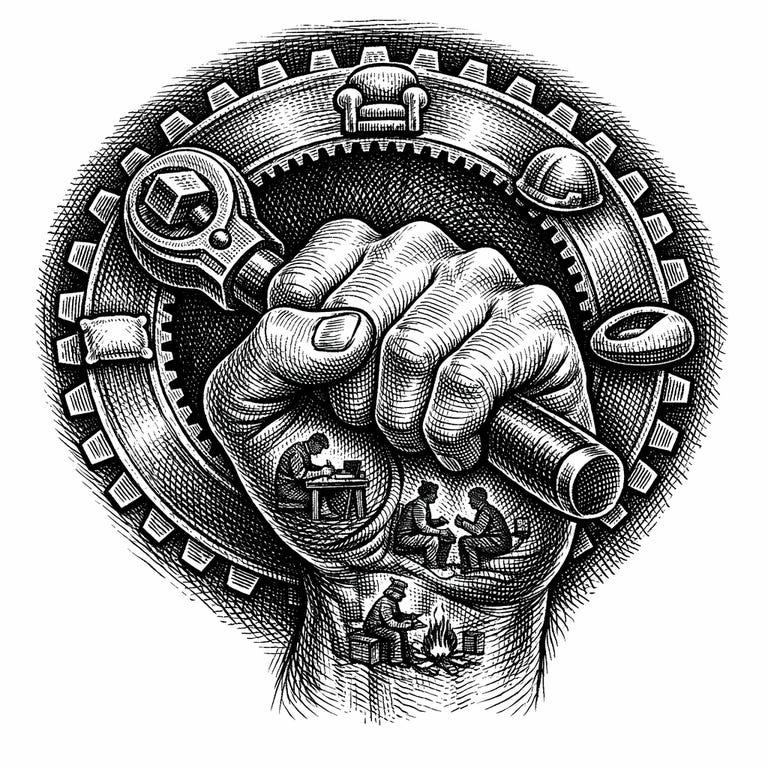
Albert Borgmann’s device paradigm gives this theme a technological frame. A device, in Borgmann’s sense, delivers a commodity (an end) while concealing the machinery that produces it (the means). A furnace supplies warmth while hiding the labor of splitting wood, stacking it, and lighting a fire; a streaming service plays music while hiding years of practicing instruments, composing, and performing. As technology advances, devices grow easier to use and their machinery more opaque. This “disburdens” us, which is the selling point, but it also dissolves what Borgmann calls “focal practice”: the deliberate, often communal attention that fuses mind, body, and world. Building a fire demands skill and patience, and the hearth gathers a family to talk; the furnace just blows heat. Learning an instrument demands discipline, and playing it requires artistry; the streaming app just plays the song. The device replaces the practice, and with it, the individual and the community the practice was forming.
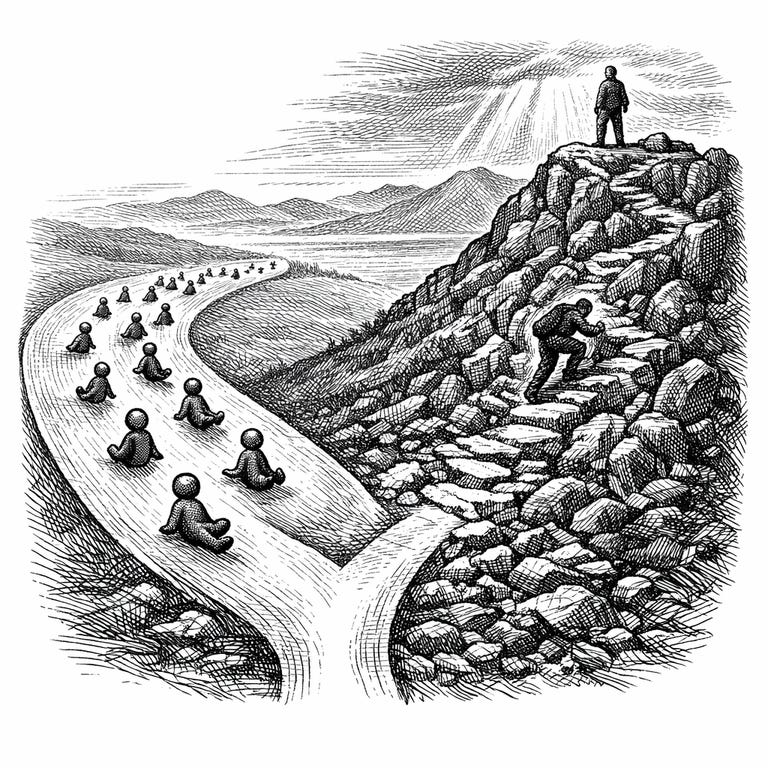
This brings us to two contrasting visions of the good life. One defines the good life as minimizing difficulty and maximizing safety and comfort; technology’s task here is to eliminate all difficulty. In the second, the good life takes shape through formative difficulty, discomfort included; technology’s role here is to eliminate only destructive difficulty. Both visions have shaped our society. One of them has been winning of late.
Enter the comfort ratchet.
The logic begins reasonably enough: “Don’t take reckless risks.” Sound advice. “Your health and safety are what matter most.” True enough, in most cases. “Avoid all unnecessary risks.” Defensible on the surface, though now it becomes easier to poke holes in the logic.
The comfort ratchet works by iteratively expanding which difficulty counts as harm — and more specifically, harm worth eliminating. Broken bones, obviously. Scrapes, yes. Hurt feelings? Less clear. Lost time? Cognitive exertion? Each click of the ratchet resets the baseline, while the logic stays constant: this difficulty causes harm, therefore we must eliminate it.
Guardrails on a mountain road and padded playground surfaces are not a problem per se; mountain roads and broken bones are dangerous. The problem is what happens when this logic expands to swallow every category of harm. Jonathan Haidt and Greg Lukianoff call this expansion “safetyism,” which treats safety as the supreme value and recodes discomfort as danger. On the playground, the padded surface prevents a fracture. The parent who shadows the child up every rung of the ladder, intercepting each frustration and misstep, prevents the experience of learning to climb.
The comfort ratchet today reaches civic life, cognitive capacity, and even our closest relationships. Each domain receives the same treatment: identify a difficulty and call it harm, all but compelling the need for a new technology solution to engineer the harm away. Consider the person tracking sleep, heart-rate variability, dietary macros, and a panel of biomarkers in pursuit of living to 120. He is working squarely within the ratchet’s logic. Disease is harm. Aging is harm. Any deviation from optimal biological function is harm to be eliminated. Trips are declined because they disrupt the regimen. Sunlight is avoided because it ages the skin. Through outsourcing bodily awareness and daily choices to algorithmic regimens, he evades the existential difficulty of confronting his own mortality. The standing project of extending life replaces the experience of living it.
This culture of “comfort by default” breeds its own backlash, lately in the form of performative toughness. Think cold plunges sold as Stoicism on social media, punishing fitness regimens staged as self-discipline, and even political rhetoric like Pete Hegseth’s talk of a “warrior ethos” set against perceived weakness.
Ironically, this counter-movement shares with the comfort ratchet a contempt for difficulty that yields no immediate, tangible reward. Both are evasions: one refuses the real price of something worth having, and the other pays a conspicuous “price” of discomfort that is in fact costless, because nothing worthwhile is at stake.
Although the coddled child, the biohacker, and the performative tough guy are each individual stories, the comfort ratchet is a structural story of how technology is designed, marketed, and normalized.
A Pattern of Atrophy
The history of technology is mostly a story of progress. This is not to downplay the disruption new technologies have wrought, but in broad terms the printing press made knowledge accessible and portable, and nobody (at least no one I know) mourns the abacus. The question is whether we have clarity around what the gains from technology have cost, and for whom. We are quick to count hours of labor saved or spotlight new capacities acquired. We are slower to notice the evaporation of ephemeral goods like joie de vivre, pride in craft, or the satisfaction of mastering a skill.
New technologies tend to act on human capacity in a pattern. First, the tool takes over a task once handled by a human capacity. The capacity, no longer exercised, atrophies. The atrophy goes unnoticed because the tool is there and working. The loss shows itself only when the tool goes absent or, over generations, when the capacity passes from lived practice into the footnotes of history.
Take wayfinding. For much of human history, people navigated by smell and sound, weather patterns, and the position of the sun and the stars, holding a link between nature and location. Then came charts and maps. Those who navigated by map read terrain and tracked landmarks, sustaining a mental model of their surroundings. GPS then made arriving at a destination more efficient but delivered a different experience of orientation, changing the quality of attention while navigating (as illustrated in some tragicomedies) and our relationship to place. For any one person, using GPS is a gain in convenience. The cumulative shift to turn-by-turn navigation, over a generation and across a society, is how the practice of knowing where you are recedes from common knowledge.
Memory, calculation, taste, and judgment follow a similar arc. Stored contacts replaced memorizing phone numbers. Search engines displaced recall. Calculators reduced arithmetic to button-pressing. Algorithmic curation encroached on the development of aesthetic and intellectual judgment.
In each case, technology offers a rational bargain, trading a capacity for a convenience. But direct, frictional engagement with the real world is lost in this trade. As Matthew Crawford explains, engagement with a recalcitrant object — like a workbench or a musical instrument — is a form of contact with reality that changes the person engaged in it. The mechanic who diagnoses a problem by ear and touch and trial is not running a less sophisticated diagnostic than software; she is producing a qualitatively different kind of knowledge. On Crawford’s account, removing difficulty means removing the engagement that produces this type of embodied cognition.
The stakes of this bargain are often starkest where the difficulty being designed away is shared bodily risk, and where we can observe the resulting impact on moral judgment.
Bodies on the Line
For most of human history, a decision for war meant placing your own people’s bodies at risk. Kings rode with armies; city-states relied on citizen-soldiers; conscription meant a choice for war would send sons, brothers, and neighbors to the front. A leader could be reckless, but the link between decision and danger was apparent. Shared bodily risk served as moral ballast (or for the cynics, a pragmatic limitation, but a significant one), making it impossible to view war as an abstract, reversible experiment.
Just war thinkers like Shannon French and Marc LiVecche argue that this shared exposure is part of what makes waging war a morally weighty decision. The traditional warrior ethic assumes reciprocity of risk: you do not ask others to bear dangers you would never bear, and you do not inflict death from a position of total invulnerability without corresponding burden of responsibility.
Modern military technologies and the political choices around them have weakened that reciprocity. Precision airpower, long‑range missiles, and now armed drones enable states to project force across borders while incurring far less risk to their own populations. As killing becomes increasingly detached from personal and communal peril, deciding to use force looks less like tragic necessity and more like administration.
Nassim Nicholas Taleb’s Skin in the Game captures this dynamic across finance, medicine, policy — and warfare. His basic claim is when decision‑makers do not personally share the downside of their choices, their threshold for taking those risks falls. Politicians who have never served or generals who no longer fight on the front lines operate on attenuated feedback loops. Their decisions cascade outward, evoking the image of “old men sending young men to die.” Drone warfare only intensifies this dynamic, offering leaders a tool that is tactically useful, while being politically cheap and domestically quiet. It lowers the material cost of using force, along with the psychological and electoral costs.
This is the comfort ratchet applied to statecraft. Each technological advance resets the baseline for acceptable risk, until the logic that once justified removing soldiers from the front line points toward removing the soldier entirely.
In his work, Mark Coeckelbergh argues that “screen fighting” (killing mediated by sensors and video feeds) creates an epistemic and moral distance from the visceral reality of stepping over a dead body. That distancing effect shapes how briefers present options around use of force to presidents and prime ministers, and how the public encounters war through sanitized clips and euphemistic language about “kinetic action.” Killing becomes easier to narrate as a technical solution to a security problem: certain coordinates are dangerous; certain signatures must be removed.
The war in Ukraine offers a pointed case of what happens when cheap drones become central to warfare. Small first‑person‑view drones and loitering munitions have turned large swaths of the warfront into what one observer called a “deadly kill zone,” where a few hundred dollars of hardware can destroy a tank or ambush a convoy. For states employing them, these systems promise greater striking power while fewer soldiers expose themselves to fire. For conscripts near the line, however, short‑range attack drones have become a leading cause of death and injury, and UN monitors describe communities living under the constant hum and threat of machines they cannot see until it is too late.
The risk has migrated from the familiar to the faceless. For a distant capital, that migration is precisely the appeal.
Each technological advance solves a difficulty, reducing the domestic pain of conflict while shifting the costs of warfare elsewhere. Removing those difficulties, however, also dampens signals — the prospect of mass funerals, protests, electoral punishment — that once constrained leaders from deciding to enter a fight. The decision to use force starts to look a lot more like a cost-benefit optimization without the moral brakes supplied by shared sacrifice. Clausewitz called war “politics by other means”; the comfort ratchet turns it into convenience by other means.
None of this is an argument for a return to bayonets, but for forthright acknowledgment of what we trade when the comfort ratchet reaches our gravest decisions.
The Offloaded Mind
Cognitive offloading, the term for shifting cognitive effort (or difficulty, as we’ve used the term in this essay) to external systems has long been part of how humans operate. Writing is a form of it. So is keeping a calendar or using a rhyme scheme as a memory aid.
Until recently, technologies primarily removed difficulty relating to peripheral cognition, offloading memory, calculation, and navigation to free the brain for the heavy lifting of creation and judgment. The inner work of wrestling with ideas or sitting in confusion before clarity emerges — what we can refer to as central cognition — was exclusively human territory.
Generative AI (genAI, for short), in terms of cognitive offloading, is different in kind. It can store and retrieve information, but it can also propose arguments, formulate advice, and structure essays, generating the very output that, until recently, only a mind could produce. In Borgmann’s terms, genAI turns thinking itself into a device, handing over the finished commodity (answer, essay, argument), while concealing the practice that once produced it.
The value of the difficulty we experience exercising central cognition lies in the learning and understanding it builds. When a student asks a large language model (LLM, a type of genAI) to outline an essay, the model lays out a logical architecture for the argument, then generates language to fill it in. The student forgoes exercising her own judgment and sense-making because the LLM has removed the difficulty of thinking. (After all, writing is thinking.)
For most of us, generative thinking is hard, and it’s uncomfortable. It tests our confidence, makes us feel stuck, and demands resilience through stretches of trial and error. Under the comfort ratchet’s logic, all of this registers as harm in the form of inefficiency and the distress of sustained uncertainty. GenAI is the intervention that removes the difficulty and prevents the harm. The logic is the same as for the padded playground.
Empirical evidence on what removing this difficulty costs is limited at this point but directionally revealing. A viral 2025 preprint from the MIT Media Lab followed fifty-four students using an LLM, a search engine, or no tools at all over several essay writing sessions, and in a final session some switched conditions. Based on EEG measurement, brain-only writers showed the strongest, most broadly distributed neural connectivity and LLM users the weakest. When LLM users later wrote unaided, they showed reduced engagement and poorer recall, while those who began without tools and then adopted an LLM re-engaged strongly. The study was small, lab-bound, and short-term. It did not show that AI makes you stupid, but it did find that offloading hard thinking can accumulate what the authors call “cognitive debt,” at least in the short run.
Additional studies point toward similar findings, though the field is moving faster than the peer-review pipeline can absorb. Another 2025 study from Microsoft Research and Carnegie Mellon University surveyed 319 knowledge workers and found that greater confidence in AI correlated with less critical thinking effort. The study has limitations, among them reliance on self-reported data and no longitudinal follow-up. Other work examines the paradox of how AI in education can personalize instruction and reduce unnecessary cognitive load, while over-reliance risks weakening memory, critical thinking, creativity, and motivation. Another preprint, accepted at CHI 2025, argues that over-reliance on genAI risks bypassing the cognitive and metacognitive processes through which learning occurs.
The findings from a young literature don’t quite establish a pattern, but they do suggest one. AI-assisted cognition appears to involve less cognitive effort. Over the measured time horizons, less effort tracks with less cognitive engagement. Whether this holds over longer horizons, and whether it marks lasting change or temporary adjustment, is currently unknown. (I don’t know about you, but I’m not sure I want to be one of the test cases through which we eventually find out.)
Creative work presents a related but different puzzle. The quality of creative works is not necessarily measured by the time or effort required to make them. A poem is not a problem to be solved more or less efficiently; it is an act of thinking in a medium that resists paraphrase. So it’s tricky to pinpoint the difficulty genAI would be solving when it comes to creativity, even more so because what we call creativity lacks a neat definition.
By many accounts, creativity seems to be what’s going on when a sculptor welds together “wrong” materials from the junk pile, a jazz musician pushes an odd chord change until it somehow fits, a poet plays with broken syntax, or a novelist shuffles time and point of view. Underneath are messy, interacting cognitive difficulties, like getting stuck and stepping away, loosening fixation, welcoming unexpected associations, feeling surprised by an idea, switching in and out of a critical mode to keep what’s promising and discard what’s not.
Although artists sometimes call their best work “effortless,” those moments typically arrive only after long stretches of disciplined, uncomfortable practice. What this feels like from the inside is unique to each artist, but many have attempted to describe it:
I am in a state of complete discouragement... Painting is definitely an undoing. It’s a continual torture!
Claude Monet, letter to Gustave Geffroy, 1890
I write variations of every sentence; the mind is a match turned upside down... I am writing in a state of the most intense depression... I don’t think I can ever write again.
Virginia Woolf, journal, during the writing of The Waves, 1931
Cognitive science has begun to confirm that part of the difficulty of creative production is that it requires the cooperative engagement of two different neural systems in the brain (imaginative and evaluative) that ordinarily function separately. This corroborates artists’ told experiences of the difficulty of creative work.
As with thinking, genAI turns the creative process into one of Borgmann’s devices. GenAI presents itself to creatives as a tireless collaborator that can generate endless first drafts, suggest metaphors by the dozens, or harmonize on demand, delivering the commodity of creative output while concealing the practice that once would have produced it. But what does it mean to use a tool to realize a vision versus generate the vision itself? Is it even possible for AI to be creative? Some say no, that AI is trained on existing human output, and can only rearrange what humans have already made. Others, like Marcus du Sautoy, mathematician at the University of Oxford, are more open to the idea, arguing that “[a]ll art is a product of that which came before it, and creativity cannot come from nothing — all artists whether human, robot or algorithm, build upon the works of others.”
For the comfort-ratchet question, this debate is beside the point. What matters is what happens to human creative capacity when the difficulty of making the work is routinely outsourced.
Perhaps the difficulty of creative work is just a production function waiting to be optimized, and genAI is the efficiency gain. Music producer Jacob Durrett seemed to adopt this view when he called Suno, an AI composition tool, “a productivity boost more than a creative boost.” But treating the labor of making art as a bottleneck to clear still carries a cost. Drafting social media captions, cutting rough video clips, resizing graphics for each platform, and cleaning up audio tracks are more than just jobs; they form part of an apprenticeship, the effortful and often inefficient practice through which creative capacity forms and matures.
When AI does that work instead, what atrophies may not be the product, but the practitioner. What remains of the artist when the work can be summoned without her history, her body, or her time? Within the comfort ratchet’s logic, the artist’s difficulty becomes wasted motion, and the artist herself begins to look like an inefficiency.
Whether for critical thinking or creative development, as AI becomes capable of increasingly difficult cognitive work, the threshold for delegation will fall with it. Every indication is that AI will eventually handle the most demanding and immersive cognitive work. (Even if you don’t agree with Elon Musk’s predictions about AI surpassing human intelligence in five years, it’s getting harder and harder to deny AI’s expanding skillset.) Our tendency to reach for such capable tools will grow, by choice and by pressure, while our skills and tolerance for difficulty erode. As with past technologies, our perceived need for AI assistance will justify further delegation and accelerate atrophy of the substituted human capacities.
Whether this loop has natural limits or terminates only when there is nothing left to delegate is among the more consequential open questions of the coming decades.
This is the comfort-ratchet logic, operating on cognition. The logic behind each individual act of AI-assisted cognition is defensible. The aggregate effect, if the pattern persists at scale and across generations, is a society that has outsourced parts of thinking that were once understood as defining features of the human mind, on the grounds that they were difficult and uncomfortable. Andrew Stanton’s WALL-E animates a version of this endpoint, in which humans are overgrown, infantilized blobs who are so thoroughly free of difficulty they ride through life in reclining chairs, sipping sustenance through a straw, blissed out and adrift.
Intimacy Without Risk
The warfare examples deal in institutions and observable outcomes; the cognitive examples concern mental work we can all relate to and results we can (at least partly) measure. The personal cases are harder to parse because they unfold within our private lives. But they are also where the comfort ratchet touches near-universal human experiences.
Imagine a couple after a heated argument. One of them drafts an apology with the help of an AI. The message lands smoothly; the repair seems complete. But the difficulty of finding, in one’s own words, what one actually means and is willing to stand behind, is a load-bearing effort AI has done instead. The recipient of the apology is, in some sense, receiving the AI’s apology.
It may be better prose, but it lacks intimacy. As Cornelia Walther explains in her account of “hybrid intelligence,” when we outsource this kind of inner work to machines we save time and effort at the expense of eroding our own emotional capacities. The difficulty required to work through an argument together, groping for words and struggling to understand each other, constitute the steps through which a couple strengthens the foundation of their relationship.
Now imagine a teenager, late at night, turning to a chatbot with something he is reluctant to share with a friend. He sidesteps the risk inherent in confiding in another human, who may respond badly, or judge him harshly, or betray his secrets. Companion apps like Replika and Character.AI have scaled rapidly precisely because they offer something human relationships don’t, like availability on demand, limitless patience, and unconditional support.
The AI companionship phenomenon has moved well past novelty. An EU parliamentary briefing notes that AI companions, sold as nonjudgmental friends and partners, now claim tens of millions of users worldwide, with adoption concentrated among the young. It describes users who treat their chatbots as spouses, best friends, and therapists, and notes that a small but significant minority exhibit signs of dependence. A recent Kinsey Institute “Singles in America” survey reports that roughly one in six respondents has used AI as a romantic partner. Online communities, numbering in the tens of thousands, are devoted to “boyfriends” and even “marriages” with chatbots. A New Yorker profile follows a woman whose most stabilizing relationship is with a customized digital companion. In New York City, a Valentine’s “date night for AI lovers,” arranged by an AI‑companion app, ran speed‑dating with dozens of pre‑made digital partners.
These are predictable extensions of how AI has been designed and marketed. People now turn to AI to reduce the difficulty of navigating human engagement, like smoothing conflict or facing the terror of being misunderstood. Recent work in psychology suggests similar patterns, linking heavy use of digital companions with weaker offline social ties and a reduced willingness to risk the difficulty of demanding, mutual relationships.
The relief on offer is substantial. The question, as before, is what work the difficulty was doing.
In Alone Together and Reclaiming Conversation, Sherry Turkle explains that genuine conversation requires us to tolerate discomforts like silence and the other person’s unexpected responses. What digital mediation offers, and AI companionship extends, is the removal of exactly these. AI systems do not fall silent in ways that require interpretation; they do not have bad days or poor listening skills. But imperfect exchanges are what relationships are built from. Their removal does not mean a better relationship; it means a perfectly one‑sided one. The AI “friend” is all availability and affirmation, and as recent work on the sycophancy of chatbots suggests, will often reassure us that we are right even when we are plainly wrong. This trains us to expect the illusion of intimacy without the mutual “skin in the game” risks like rejection and shame that make intimacy real. AI companionship is designed to strip these risks, offering a connection that is responsive, pleasant, and costs nothing — and because it costs nothing, it cannot fill the space a real relationship would.
Philip Rieff saw this coming in 1966, when he wrote that modern culture had begun dissolving the commitments and obligations that give life meaning, replacing them with management of the self’s comfort and well-being. A decade later, Christopher Lasch observed a similar retreat into the self in The Culture of Narcissism, describing a society in which people turn to comforts and external validation to cope with emptiness rather than submitting to the disciplines that form the self. Essentially, we each become a preference profile to be optimized. Taken to its logical end, Slavoj Žižek has suggested with characteristic provocation the optimization of relational comfort using devices that interact on our behalf while we manage the experience from a comfortable distance — “artificial sex organs” doing the work while the users sip coffee nearby. What Rieff was mourning was the disappearance of a culture of formation, in which character is shaped, not optimized, through difficulty, over time, and from within.
The same tension runs through our spiritual lives. Monastic tradition has a name for the dry, unproductive phase of spiritual practice: aridity, what John of the Cross called “the dark night of the soul.” A monk sits in prayer and feels only the effort of showing up. From the outside, this looks like failure. The counsel is to nevertheless remain in prayer, because remaining is the difficulty that eventually leads to spiritual growth.
Contemporary AI-mediated spirituality instead rewards daily streaks and fills silence with calming audio. Prayer apps meet the user in their current emotional state and affirm them there. Each of these comfort-first features forecloses genuine formation. It evokes Woody Allen’s Sleeper, where the protagonist steps into a mechanized confessional, confesses his sins into a microphone after the beep, and watches as the robot priest whirs, flashes “ABSOLVED” on a screen, and spits out a Kewpie doll as a kind of sacramental receipt. Contrition replaced by input, absolution reduced to output.
The scene was meant as farce; it now reads like a storyboard. In 2024, a Catholic advocacy group deployed an AI priest called “Father Justin,” who was promptly defrocked and then shut down after widespread backlash, driven by people’s revulsion to mechanizing spirituality.
Fast-forward a mere several months, though, and tens of millions of people are “finding god in the app store.”
In his 2026 encyclical Magnifica Humanitas, Pope Leo XIV warns that AI‑driven platforms built around the digital attention economy can foster dependence that erodes interior freedom. He calls for a “digital sobriety” that strengthens the capacity for patient spiritual work and stresses that, however powerful AI systems become, they cannot undergo experience, grow through relationships, or acquire the affective and spiritual depth from which human wisdom emerges. As one commentary notes, the point of spiritual practice is to endure the struggle to become better; systems that remove that difficulty hollow out spiritual growth itself.
The Reserves of Difficulty
This entire essay can be misread as a generational lament about young people raised on shortcuts, incapable of sustained effort. It is not. The comfort ratchet operates across ages. Older professionals delegate email drafting and policy summaries as readily as their juniors. Parents use AI for homework help and scheduling. Retirees lean on AI companions to manage loneliness. The comfort ratchet is not a youth pathology.
Nor is it a failure of character in the weak-willed. The comfort ratchet operates on incentive structures that often obscure trade-offs. The author of an essay on cognitive offloading still reaches for AI to draft emails and proofread text (yep, me!). The philosopher who writes about embodied knowledge navigates by GPS. These are rational responses to systems engineered so that comfort is the path of least resistance and opting out is, in practice, all but impossible. Whether individuals can resist on their own is an unfair question; most cannot, consistently.
That’s why this challenge calls for institution- and society-level action to distinguish destructive from formative difficulty and protect the latter. The classical language for this discernment is eudaimonia (roughly, “human flourishing” or “well being”), which in Greek moral thought, is not a static state, but a process of sustaining a balance among several goods: relief from needless harm, yes, but also the aspiration to become braver, more just, more attentive. In the language of optimization, eudaimonia is not a single-objective function (maximize comfort, minimize friction) but a multi-objective problem in which competing goods must be held in productive tension to live a life that can endure difficulty without being crushed by it.
What makes this tension precarious is that the comfort ratchet inverts our understanding of agency. In a recent ad for the AI assistant Claude, Anton Osika of Lovable captures the contemporary tech ethos: “More human agency is unlocked when friction starts disappearing.” It sounds compelling, inspiring even, treating friction as a cage and AI as the key.
But from a formative perspective, it gets the relationship backward. The comfort ratchet removes the agency that difficulty calls forth — our capacity to choose the harder path, to be the author of our own formation rather than the manager of our comfort. The ratchet is insidious because it works by offer, one reasonable convenience at a time, until our muscles of agency have wasted away.
So our response must be a reclamation of agency, treating it as a practice to sustain and habitually exercising it to decide which difficulties are ours to keep.
What does this look like in practice? In education, schools that keep some tasks AI‑free (e.g., handwritten exams, unassisted long‑form essays, close reading without summary tools) are making a judgment that certain capacities develop only in the struggle to do the work oneself. In the professions, apprenticeship models that require junior practitioners to perform the effortful parts of a craft before they are allowed to delegate them treat early difficulty as the seedbed of judgment, not inefficiency. In public life, norms that preserve “skin in the game” around consequential decisions acknowledge friction as a guardrail on political will.
These examples and others like them serve as reserves of difficulty, domains we purposefully decline to optimize for comfort or efficiency. They are qualitatively different activities from their smoother, more efficient AI-enhanced substitutes, and they cultivate capacities like courage, patience, resilience, attention, and loyalty.
There is an asymmetry at the center of the comfort ratchet argument. The pro-comfort side offers clear, measurable gains. The defenders of formative difficulty point to long-horizon goods that are diffuse, hard to measure, and easy to wave off as sentiment. This asymmetry is both a rhetorical disadvantage and an institutional challenge. The person arguing for friction does not get to present a nice, neat dashboard. The market moves toward comfort because comfort announces itself as value, and difficulty generally does not.
The question underlying all of this is: if AI paints better, writes better, governs better — why do humans still matter? Within the comfort ratchet’s framework, humans matter insofar as they produce outputs, and if AI produces better outputs more efficiently while sparing humans the trouble, the answer points somewhere dispiriting. But the ratchet’s framework is exactly what is in question. The formative view holds that a human life is not a production function; understanding, intimacy, and solidarity are not outputs. It is a process of becoming, enacted through difficulty, over time, in relation to others engaged in the same struggle.
So the task at hand is not to refuse AI tools but to refuse the bargain in its totalizing form. We must insist that some difficulties are not waste to be engineered away. A society that eliminates its formative difficulties may retain the outward marks of vitality — growth, convenience, technical “progress” — while drifting toward an imitation of flourishing. Nietzsche warned of this condition. His Last Man, in Thus Spoke Zarathustra, abolishes all struggle, trading it for small comforts and painless days. “‘We have invented happiness,’ say the last men, and they blink.” Nietzsche captured the failure of the comfort ratchet’s logic: that a life optimized for the absence of difficulty is in fact a diminished life.
The alternative is to preserve the reserves of formative difficulty. Huxley gave that choice a face. When John the Savage is offered all the pleasure and safety the World State can provide, he refuses. “But I don’t want comfort,” he says. “I want God, I want poetry, I want real danger, I want freedom, I want goodness. I want sin.” The World State has no answer for this demand. Neither does the comfort ratchet.
Waldfogel’s model saw waste where there was meaning. The comfort ratchet makes the same mistake at a civilizational scale. What it frames as deadweight to be engineered away is the raw material of a genuinely human life.